Category: Television

Fruits Basket Episode 26: The Evolution of Yuki

Fruits Basket Episode 26: The Evolution of Yuki

The first episode of the second season of Fruits Basket, the series about a teenage girl named Tohru Honda who befriends members of a mysterious family cursed to transform into animals, has been released to the world. I wish I could say I saw the new episode at one of Funimation’s “sneak peek” theatre showings in the United States decked out in Machi cosplay and Yuki merchandise, but they were all cancelled due to the COVID-19 pandemic. Instead we’ll be watching scenes from the original manga animated for the first time every week together.

As a longtime fan of the manga by Natsuki Takaya, the way “Hello Again” perfectly ushers in the second season’s new material (especially regarding Yuki Sohma) has me hyped. In honor of the second season, this will (hopefully) be my first in a series of posts recapping and analyzing each episode. I may as well write something regularly while I’m staying home. This time the spotlight is on dear rat boy, his future, and his new friends. Newcomers and fans of the 2001 anime series will soon find there’s much more to Yuki than the early episodes.

Continue reading “Fruits Basket Episode 26: The Evolution of Yuki”

12 Days of Anime: Ash Lynx is Dead, Long Live Ash Lynx

12 Days of Anime: Ash Lynx is Dead, Long Live Ash Lynx

On this day last year, the awaited final episode to Studio MAPPA’s anime adaptation of Banana Fish aired. Some viewers had dreaded it ever since the anime’s announcement, some learned along the way and joined them, and some watched it unfold without spoilers. They dreaded it not because they’d be left with no more episodes to watch, but because of the nature of the ending.

The rest of this post contains spoilers for Banana Fish and brief discussion of child sex abuse.

Continue reading “12 Days of Anime: Ash Lynx is Dead, Long Live Ash Lynx”

12 Days of Anime: Reconstructed Body, Reconnecting Partners

12 Days of Anime: Reconstructed Body, Reconnecting Partners

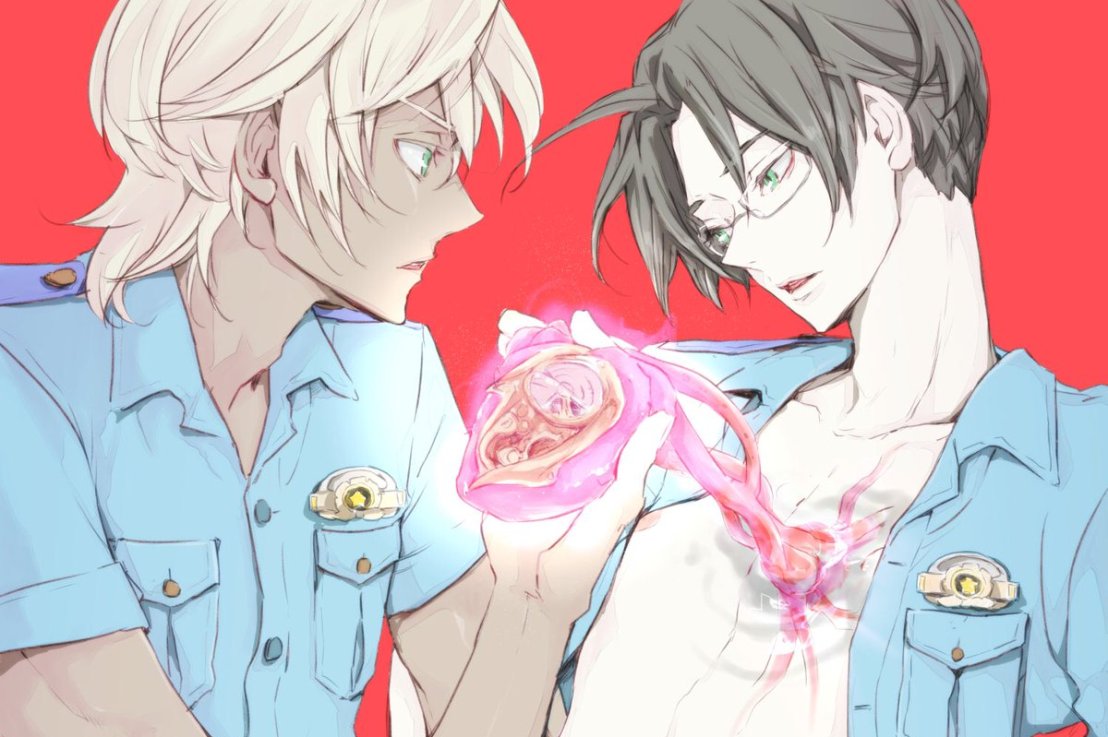
Reo Niiboshi and Mabu Akutsu, a pair of fictional police officers, debuted in the manga Reo and Mabu: Together They’re Sarazanmai by Misaki Saitou. While they spend their days raising a lost child named Sara in Reo and Mabu, they appear as antagonists who transform humans into zombies of desire in the following Sarazanmai anime television series. The second episode of Sarazanmai reveals their process of creating zombies (offering humans to the Otter Empire while dancing), as well as the fact Mabu has a mechanical heart that runs on desire energy.

The anime leaves Mabu’s robotics ambiguous, resembling both cyborgs and androids. His heart is definitely mechanical, which alone would make him a cyborg, but the rest of his body is unclear. His chest turns transparent and Reo extracts his heart from it without bloodshed. He may have more mechanical organs, based on the Chief Otticer tinkering with his insides during “maintenance” surgeries. The Chief Otticer and Reo refer to Mabu as a “doll” as if he were entirely artificial. Sarazanmai doesn’t focus on robotics, but it has a place in robot fiction with how Mabu being a “doll” affects his relationship with Reo.

The rest of this post contains spoilers for Sarazanmai and discussion of ableism.

Continue reading “12 Days of Anime: Reconstructed Body, Reconnecting Partners”

12 Days of Anime: The Ones Who Walk Away From Daigo

12 Days of Anime: The Ones Who Walk Away From Daigo

In 2019, director Kazuhiro Furuhashi and series composition writer Yasuko Kobayashi adapted Osamu Tezuka’s classic manga Dororo to television. They not only lengthened the story, but brought it to completion more than the rushed ending of the original manga. It still follows Hyakkimaru, a young man seeking to reclaim his stolen body parts from demons, and Dororo, a rambunctious thief who looks up to him. Rather than potential for disability in the premise, Dororo (2019) focuses on issues of autonomy and justice by framing Hyakkimaru’s quest as morally driven. He retaliates against a corrupt leader willing to steal the livelihood of another and aims to take back what is rightfully his, which distracts from the potential ableism of aiming to be “cured.” Still, they missed the opportunity to incorporate the rights of disabled people into themes of autonomy and anatomy.

Instead, Dororo (2019) looks at how Hyakkimaru’s body parts were supposedly sacrificed for the greater good. The central ethical issue also rests in “The Ones Who Walk Away from Omelas,” a science fiction short story by Ursula K. LeGuin first published in 1973. InOmelas,” LeGuin posits a utopian society that operates on the torture of a single child, which metaphysically allows the land to prosper. William James’ argument in “The Moral Philosopher and the Moral Life” that humans possess innate morality because they feel repulsion at such a hypothetical society inspired LeGuin, who disagrees with the assumption. LeGuin writes that while the treatment of the child sickens the citizens of Omelas, most of them accept the bargain and go on with their lives.

The rest of this post contains spoilers for Dororo.

Continue reading “12 Days of Anime: The Ones Who Walk Away From Daigo”

The Voxy Bunch and the Legacy of Animated Queer-Coded Villains

The Voxy Bunch and the Legacy of Animated Queer-Coded Villains

Over the last few years, the amount of confirmed LGBTQ characters in animated television aimed at children in the United States has significantly increased. Media for children has additional hoops to leap through when including LGBTQ characters, such as fear of “corrupting” children into queerness or exposing them to “sexual content” of same-gender relationships. We’re currently at a turning point between reliance on subtext for depiction of LGBTQ people (such as under the Hays Code) and more openness about LGBTQ topics, and all the complications that come with it.

OK K.O.! Let’s Be Heroes on Cartoon Network juggles straightforward representation with the more nebulous. As brief as it is, Enid is deliberately drawn riding vehicles with a bisexual pride sticker, the same one Rebecca Sugar used to come out in real life. Lord Boxman and Professor Venomous, the main antagonists of the series, come across as queer in another less direct way. Boxman seeks business partnerships with other supervillains of any gender, given the same weight and imagery as if they were romantic relationships. He eventually joins forces with Professor Venomous, who previously dated a woman. Together, Boxman and Venomous are ostensibly a same-gender couple under the bisexual umbrella. Showrunner Ian Jones-Quartey later confirmed via Twitter that Boxman is pansexual and Venomous is bisexual.

On paper, two major antagonists being queer(-coded) sounds unfortunately like yet another offensive stereotype in cartoons. However, the big picture is much more complex. OK K.O. has queer characters on both the hero and villain sides of Lakewood, and even that hero and villain divide becomes blurred.

The rest of this post contains major spoilers for OK K.O.! Let’s Be Heroes.

Continue reading “The Voxy Bunch and the Legacy of Animated Queer-Coded Villains”

Otterly Internalized Oppression

Otterly Internalized Oppression

There is truly a lot to unpack in Sarazanmai, the latest anime television series directed by Kunihiko Ikuhara about a trio of secretive young boys transformed into kappas and tasked with saving Asakusa, Tokyo from giant thieving zombies. The zombies in question are created by a mysterious duo of police officers named Reo and Mabu, working under the even more mysterious Otter Empire.

In the final episode, the Empire’s Chief Otticer of Science and Technology sings “I am an abstract concept.” In the end, the force opposing the Kappa Kingdom does not physically exist. They are merely social constructs borne out of the human (and kappa) characters. However, that’s not to say they’re weak or unstable. They’re strong enough to wage a war against the Kappa Kingdom, advanced enough to transform humans into zombies and harvest their desire energies, and manipulative enough to control Reo and Mabu.

In Sarazanmai, oppression is not so much enacted by living actors as by concepts embedded in society. The abstract nature of the Otter Empire goes to show how internalization of oppression, when systematic oppression negatively impacts the self-image of the oppressed group by believing in their “inferiority,” can damage a connection like that of Reo and Mabu’s as much as external forces and systems. At one point, the otters manifest as a sexually menacing version of Reo he struggles to accept. It is not a true reflection of his attraction to Mabu, but one twisted by internalized homophobia, colorism, and classism. (Although I am white and cannot speak to colorism from personal experience, I felt it would be remiss to not incorporate colorism into my analysis.)

The rest of this post contains spoilers for Sarazanmai, as well as discussion of homophobia, colorism, classism and rape.

Continue reading “Otterly Internalized Oppression”

Rainbow Releases: Winter 2019

Rainbow Releases: Winter 2019

In 2018, we introduced an anime convention panel called Rainbow Releases to highlight LGBTQ-related anime and manga coming to the United States in English. We plan to continue hosting this panel so long as there are LGBTQ titles to discuss and conventions will have us, and thankfully 2019 has plenty. Thank you to everyone who attended at Chibi Chibi Con 2019!

Last year we transcribed our midyear panel as a single blog post, which left out unprecedented works later in the year such as Zombieland Saga. This year we plan to keep a simple list of all releases on a Rainbow Releases: LGBTQ Anime and Manga of 2019 blog page, with in-depth blog posts looking back on each season as we move through the year. With all that said, here’s winter 2019!

Continue reading “Rainbow Releases: Winter 2019”

Taste, Disability, and Metaphor: De/humanization in Kamen Rider OOO

Taste, Disability, and Metaphor: De/humanization in Kamen Rider OOO

Today is Anosmia Awareness Day and I am anosmic, meaning I was born without a sense of smell. It hasn’t come up on this blog until now because anosmia is so underrepresented in fiction. There are minor characters here and there–Latula Pyrope in Homestuck, Aunt Selma in The Simpsons, etc.–and even then their anosmia is only briefly mentioned for humor or scent-related plot points. The penultimate episode of Futurama has close to a character arc about anosmia, in a parody of the 1931 film City Lights. In the episode, Zoidberg falls in love with an anosmic woman named Marianne who doesn’t realize he reeks. The episode doesn’t name Marianne’s condition as anosmia and she’s ultimately cured, but it does challenge the social construction of “bad” and “good” smells as she prefers Zoidberg’s odor to flowers. Even then, Marianne only gets one episode to herself. She’s only a parody of a blind character, not one envisioned as anosmic to begin with.

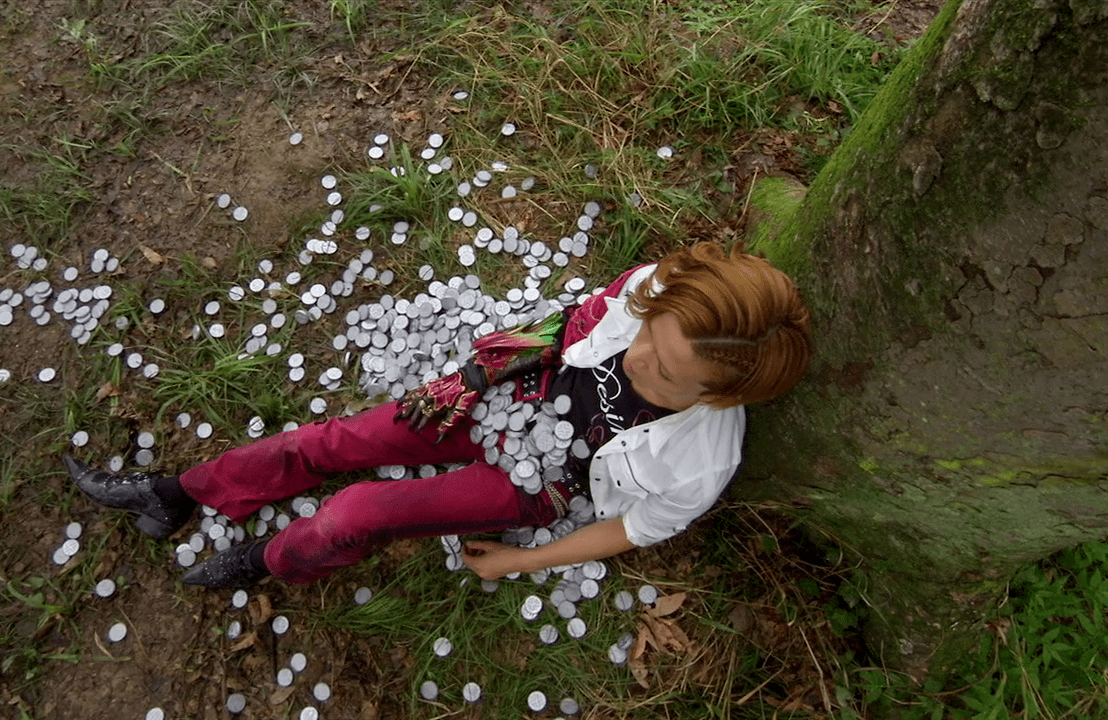
The story that’s spoken to me the most as an anosmiac is much longer, but more metaphorical. Kamen Rider OOO isn’t about anosmia per se, but does question what physical sensations have to do with making someone “complete.” In the 21st incarnation of the Kamen Rider tokusatsu television series, a young man named Eiji Hino transforms into the superhero Kamen Rider OOO with the ability to activate animal-themed medals. He was granted this power by Ankh, one of five ancient monsters known as the Greeed created by alchemists from experimentation with animal souls. The Greeed were designed as “incomplete” beings, made up of ten animal medals but “born” into consciousness through removal of the tenth. Four of them seek to recollect their core medals by creating monsters of the week, spurring battles with Kamen Rider OOO and Ankh.

This rest of this post contains spoilers for all of Kamen Rider OOO and related crossover films.

Continue reading “Taste, Disability, and Metaphor: De/humanization in Kamen Rider OOO”

What the Future Holds for Spider-Verse in the Hands of Voltron Showrunners

What the Future Holds for Spider-Verse in the Hands of Voltron Showrunners

December 14th of 2018 saw the release of not one, but two monuments in popular culture. One was the highly anticipated Spider-Man: Into the Spider-Verse, an animated film starring Shameik Moore as Miles Morales. Before the film’s premiere, Sony announced a sequel and a spin-off film in the works. Joaquim Dos Santos has been confirmed director for the sequel. At the moment, Lauren Montgomery is in talks for directing the spin-off. Dos Santos and Montgomery are fresh off their work as executive producers of Dreamworks’ Voltron: Legendary Defender, which had its eighth and final season on Netflix the same day Spider-Verse hit theaters. Audiences met Spider-Verse with critical acclaim, while the same cannot be said for Voltron season eight. Responses ranged from lukewarm to furious. After season seven left some fans frustrated with the death of a gay man of color character and other developments, season eight disappointed many more with the ending (including the deaths of more characters of color).

Voltron and Spider-Verse have more in common than a release date, however. Without getting into spoilers, the plot of season eight and themes of grief bare a striking resemblance to those of Spider-Verse. Not that one ripped off the other, but that they both aimed to tell stories about loss and family. The delicate consideration and authenticity of marginalized characters simply made audiences more receptive to Spider-Verse. If the Voltron showrunners couldn’t carry out something so similar to Spider-Verse with the same praise, how are they supposed to follow it up well?

This post contains spoilers for Voltron: Legendary Defender and Spider-Man: Into the Spider-Verse. Also, a disclaimer: this is not meant as an attack on the showrunners (or any crew member) of Voltron as people. This is a critique of the TV show they produced and their role as storytellers.

Continue reading “What the Future Holds for Spider-Verse in the Hands of Voltron Showrunners”

Favorites of 2018

Favorites of 2018

It’s that time of year again. Karleen and Malia have rounded up their favorite (not necessarily the best) media of the year enough times now it officially has its own tag: Favorites of the Year.

Continue reading “Favorites of 2018”