
The third season of GX introduces Jesse Anderson, one of four international transfer students to Duel Academy. In the Japanese version, Johan hails from Northern Europe, while in the English version he speaks with an American country accent. Jesse serves as an homage to Ryo Bakura, Yu-Gi-Oh’s earliest queer-coded character with an androgynous appearance that leads to homophobic harassment in manga chapter 50. Like Bakura, Jesse enters the story as a friendly gamer and transfer student who ends up possessed by a supernatural villain.
Most of my analysis in this post comes from the original Japanese version of GX, so this will refer to him as Johan and other characters by their Japanese names from here on. In the Japanese version, voice actresses Kanako Irie and Rica Matsumoto play Johan and Bakura respectively, making them some of the only male human characters played by women in the franchise. This also includes Masami Suzuki as Sho Marufuji (Syrus Truesdale), whose soft and high voice embodies his immaturity as a duelist and matches his small frame. For Johan, Irie’s voice paired with Johan’s masculine first person pronoun “ore” and boyish character design make for an androgynous first impression.
While Kazuki Takahashi named Bakura after gay icon Ryo Asuka from Devilman, “Johan Andersen” may come from the middle and last names of the Swedish actor Björn Johan Andrésen, made internationally famous for his role in Death in Venice. In an interview filmed for the documentary The Most Beautiful Boy in the World, mangaka Ryoko Ikeda explains the impact Andrésen had in Japan on manga aimed at girls: “I think all we manga artists are inspired by him on a deeper level. Each one of us, but in different ways. Lady Oscar in my manga, The Rose of Versailles, is a girl who dresses as a boy. The character is entirely based on Björn. He was the model.” For mangaka like Ikeda, Andrésen’s “beauty” inspired the androgynous appearances as well as the gender role-bending behaviors of their characters.
Judging by his name, Johan draws from Andrésen and his cultural impact in Japan. Johan doesn’t have the blond wavy hair of Andrésen or the characters he inspired, but does hail from Europe and has an androgynous voice. His perpetually knitted eyebrows paired with thick eyelashes and round irises harken to the designs of characters like Lady Oscar and Gilbert in Kaze to Ki no Uta. Unlike Oscar and Gilbert from Western Europe, Johan comes from Andrésen’s home region of Northern Europe. By the time GX aired, Scandinavia’s “reputation as a haven for queer people” in the 1990s due to its legal rights for LGBTQ people had only grown. For example, all Nordic countries had legalized homosexuality and many legally allowed civil unions for same-gender partnerships before season 3 aired. With that said, sharing names and heritage (compared to the more vaguely inspired Oscar) comes with the baggage of Andrésen’s disdain for becoming internationally synonymous with the role of Tadzio. My analysis doesn’t mean to imply that Andrésen himself informs the queer-coding of Johan, but that the archetype he inspired does. His name calls back to the origin of the archetype, albeit in a way that may hit too close to home.

Besides the cultural references and allusions, the chemistry between Judai (Jaden) Yuki and Johan also speaks to his implicit queerness. They quickly become friends for their shared love of Duel Monsters, as well as the fact they can both perceive duel spirits. Multiple characters remark on the similar attitudes between Judai and Johan, but they have their differences as well. Whereas Ed (Aster) Phoenix, Judai’s previous rival and counterpart in season 2, also used “HERO” monsters in his deck; Johan instead plays with a set of animals that transform into gemstones. Rather than strength symbolized by masculine humanoids, his Crystal Beasts have the special ability to switch between play as monster or spell cards. The duality and fluidity of his strategy, reflected in his own androgyny, make Johan a worthy rival.
From Sho’s point of view, Johan replaces him as Judai’s closest friend. Sho and Johan have dueling in common, but the latter doesn’t share the former’s enthusiasm for card crushes. Throughout the series, Sho has an attachment to the iconic “Dark Magician Girl” that borders on infatuation. A sentient Dark Magician Girl exists on the spiritual plane, but Sho cannot perceive her and thus mostly knows of her as a fictional character. Even in terms of the Duel Monsters game, he doesn’t utilize the card for play. He instead builds decks of Vehicroids, an archetype of cartoony modes of transportation that reflect a childish masculinity in their resemblance to toys stereotypically designed for boys. In episode 36, he calls DMG one of his “card crushes” in English and “idol cards” in Japanese. Though he doesn’t have an actual girlfriend, his card crushes characterize him as heterosexual.
Whereas Sho’s love for DMG lies in her being out of reach and imaginary, like a fan toward their favorite idol singer or fictional character; Johan has the ability to directly communicate with cards as spirits, which prevents him from objectifying them. In fact, he considers his signature Crystal Beast monsters his family members. He shows no interest in the girls of Duel Academy, unlike how Sho “can easily fall head over heels for a pretty girl” according to his Tag Force profile. Johan’s Tag Force 2 profile states, “Nobody knows what kind of girls he likes. If the right young lady does come on the scene though, we wonder if the Crystal Beasts will then call a family meeting…” which leaves potential romance with a girl merely hypothetical. Although girls flock to similarly beautiful “bishounen” like Ryo Marufuji (Zane Truesdale) and Fubuki Tenjoin (Atticus Rhodes), they don’t to him. Johan would rather play against duelists like Judai and Ryo, and in the Japanese version Judai returns that attention with romantic feelings (according to Yubel, who asks if all the love bestowed onto them now belongs to Johan in episode 155).
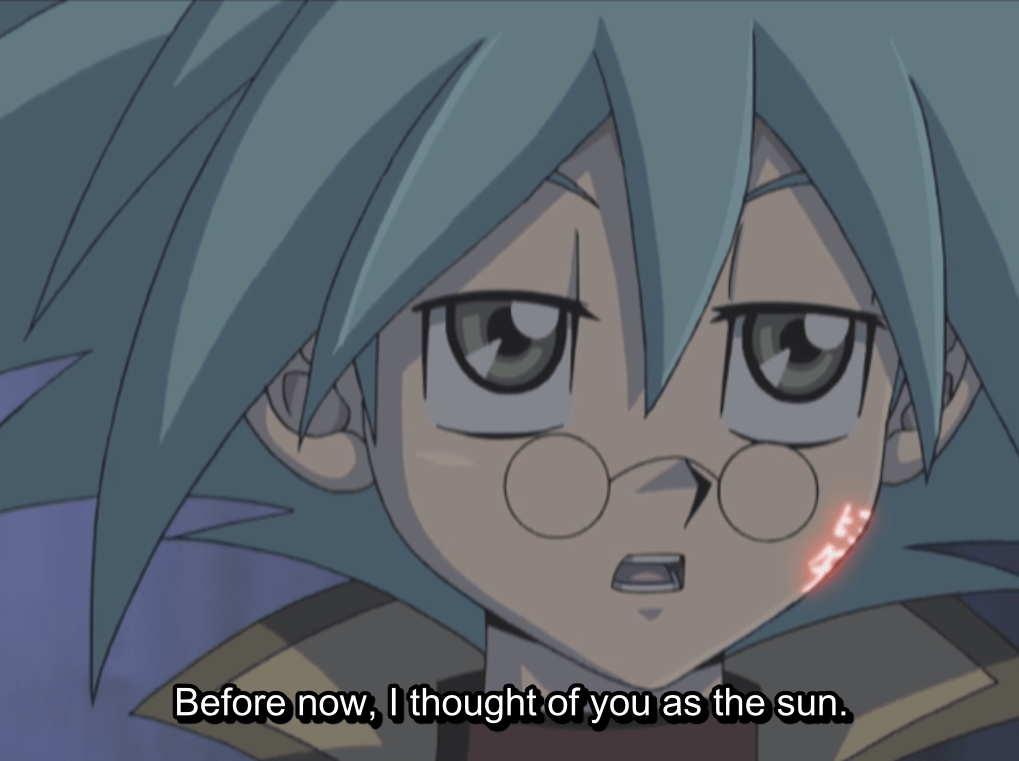
In contrast, Judai does not return Sho’s devotion (which goes so far that Fubuki interprets it as same-sex attraction in episode 64) with an equal level of appreciation. Sho sees Judai as an aspirational figure, rather than an equal. In only the second episode of GX, Judai objects to being called “aniki” (“bro”) by Sho because he doesn’t believe in hierarchy between duelists; but Sho goes on to do so against his wishes for the entire series. This hero worship only leads to greater disappointment when Judai lets him down and Sho feels ignored. In episode 136, his frustration with Judai’s disregard for his friends leads to chewing him out and running away; though in episode 137 he reflects on their friendship and decides to watch over Judai even if he turns evil.
Johan doesn’t have insecurities like Sho, as he joins the story post-self actualization of bonding with the Crystal Beasts. He’s still searching for a mystical tablet to create a card of his boss monster “Rainbow Dragon,” but he doesn’t have to prove himself as a duelist or a man. Instead he can have fun with Judai as an equal, which makes fertile ground for a friendship. They make a great team in the spirit world that Yubel strands Duel Academy and its students in. Everything goes smoothly, until Johan sacrifices himself in order for the rest to return home in episode 130. Unfortunately, Judai’s focus on Johan leads him to neglect his well-being and other relationships as he traverses across dimensions to find him.
While Judai searches for Johan, Yubel takes possession of Johan’s body. Johan serves as an extension of Yubel as a character to a degree, considering the length of time he only appears as their vessel. Kanako Irie’s voice acting resumé has only two previous roles (including GX’s own femme fatale vampire Camula), which have more in common with Yubel than Johan to the point she may have been cast with the former in mind. With that said, Johan and Yubel have their differences as characters. Even though they both exhibit gender variance, they deviate from gender roles in different ways. While Johan’s androgyny falls under socially acceptable “soft masculinity” and his warmth toward Judai creates a straightforward bond, Yubel embodies a more alienating queerness.
Johan has his own androgyny based in physical appearance, cultural heritage, and Duel Monsters playstyle before ever encountering Yubel. Even though he floats that he and Judai may have “met before,” nothing suggests he descended or reincarnated from Yubel the way Judai did from the Supreme King. In fact, Yubel changes into clothes that show off Johan’s muscular upper body, robbing him of his personal gender expression for their own purposes (of demonstrating sadomasochistic love for Judai).
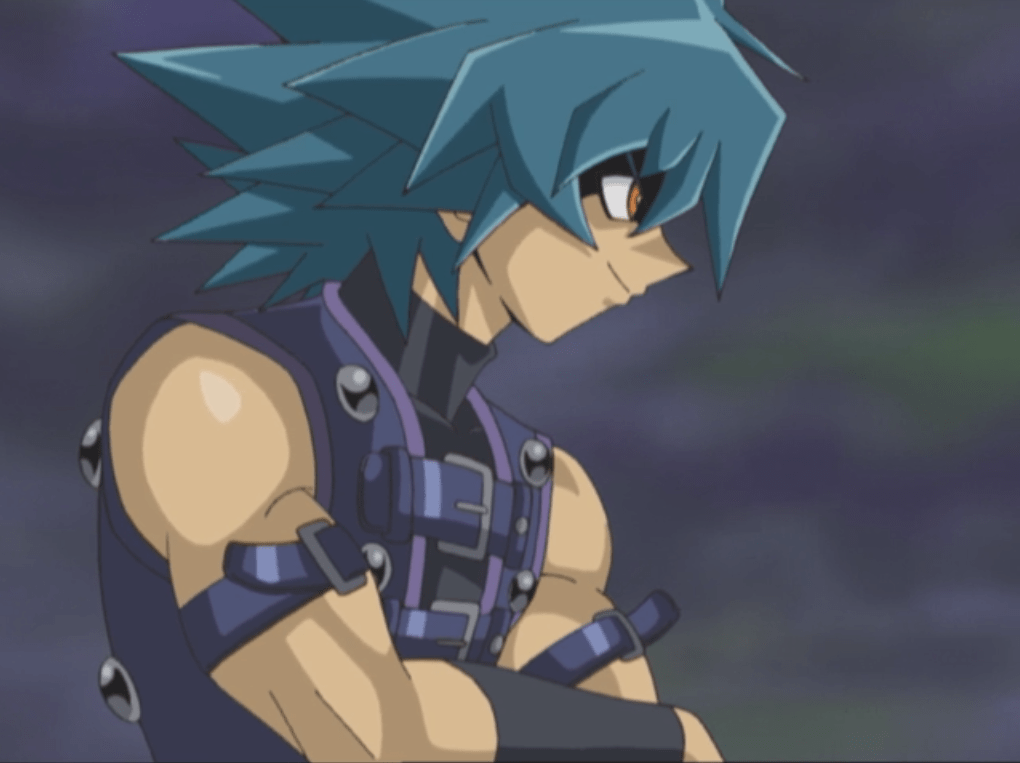
Due to Johan spending a large portion of season 3 episodes either missing in action or possessed by Yubel, GX doesn’t dwell on his feelings for Judai as much as vice versa. Judai says he was attracted to Johan, and Yubel also recognizes Johan as Judai’s new love. After the reveal of Yubel and the Supreme King’s romantic history, Yubel’s assertion that Judai replaces them with Johan becomes more romantic in retrospect. Johan doesn’t confirm nor deny his feelings for Judai, but they remain close and keep in contact after his time at Duel Academy.
In season 4, Johan gets to exist outside his relevance to Yubel. He returns in episode 172 to team up with Judai again, and goes on to participate in a battle royale duel with him and Yusuke Fujiwara possessed by Darkness (Nightshroud) for the fate of the world. Darkness attempts to manipulate Johan’s innermost desire to win against Judai, but Johan asserts that their rivalry doesn’t facilitate animosity like that. They may be competitive, but it doesn’t cross into unhealthy, showing how deeply they care about and respect each other.
GX ends with Judai and Johan’s relationship open-ended, but that doesn’t ultimately determine the nature of their relationship. Couples like Daichi (Bastion) Misawa and Tania or Samejima (Sheppard) and Tome (Dorothy) also end in proximity without outright confirmation. Judai leaves behind everyone but Yubel, Pharaoh, and Daitokuji (Banner) to travel the world (not that he doesn’t love the others); not just Johan. More importantly, GX pairs Johan with Judai as the last humans standing against Darkness for the series finale; rather than a long-term friend like Sho or another returning exchange student like Austin O’Brien (Axel Brodie).
You can’t discuss Johan without discussing Judai and Yubel, so we’ll delve into them next time.
 Coherent Cats
6 thoughts on “Get Your Gender On: Jesse Anderson”